AIM
The Loch Ness Regional Project is to improve and ensure future resilience of water quality through addressing the Trihalomethanes (THM) and Cryptosporidium risk at Invermoriston and Fort Augustus WTW’s through construction of new water intake in Loch Ness, 15km pipeline and water treatment works. The project is being delivered for Scottish Water by the alliance delivery partner (Efficient Service Delivery) a joint venture between Black & Veatch, Galliford Try and MWH Treatment.
To promote sustainable development, the final route alignment for the new main route alignment, positioning of new works and works in and around Fort Augustus was selected following extensive discussions and engagement with landowners and statutory consultees (Highland Council, SEPA, Scottish Canals and Ness fisheries) and environmental specialists to minimise disturbance to endangered species, sensitive habitat (minimise tree felling and ground disturbance) and undertaken as much as possible outside holiday season to reduce impact to the Great Glen Way (GGW). The route through the forest was directed in such a way that the trees in and surrounding the construction areas were individually surveyed and plotted. This survey was overlaid onto construction drawings and only trees directly conflicting with the water main alignment footprint were removed.
ACHIEVEMENTS
Design and construction planning allowed for the mitigation of extensive environmental sensitives.
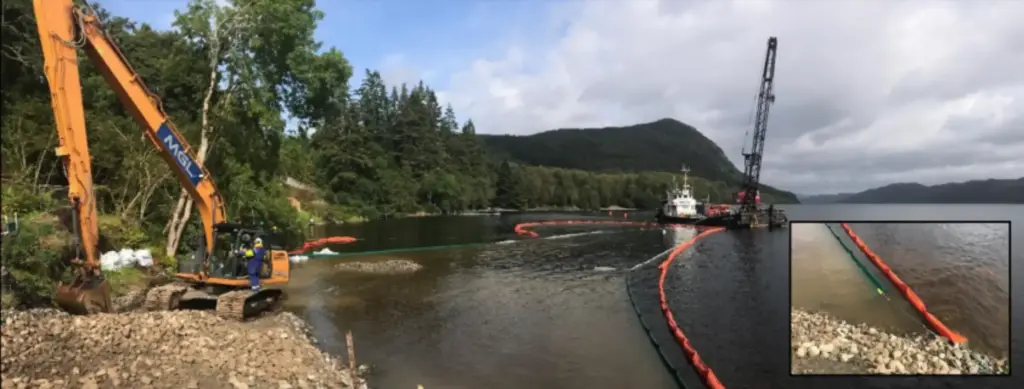
At the Raw Water Intake (RWI) into Loch Ness, timing restrictions due to fish migration in the River Morriston SAC meant that works not only had to be completed in tight window of June-September, but mitigated risk. Floating silt curtains and oil booms on the loch and silt fencing on land, prevented risk, resulting in no pollution incidents. Works were completed within the allotted time frame.
Most of the works was in ancient forest woodland, providing habitat for the UK’s most protected species including birds, bats, red squirrels and pine martens. Engaging specialists and surveys over a period of 10 years prior to scheme start and early within the programme avoided significant disturbance and minimised tree clearance. Any trees removed were recycled on site to form habitats.
Community engagement with residents and businesses was essential. The programme was adjusted and works completed outside high-peak tourist season. Over 3,500 pieces of correspondence were sent to the community and noticeboards
were erected informing walkers of phasing and route closures on the GGW. A shuttle minibus was provided on the closed sections to transport walkers during works.
IN DETAIL
What did the project involve doing and why did you do it?
• RWI and pumping station at Loch Ness, near Invermoriston
• A new raw water rising main to the new WTW.
• A new 1ML 3 stream nano-filtration WTW and new clear water tank constructed just south of Invermoriston,
• Pumped main from the new WTW in Invermoriston to a new Service Reservoir located above Fort Augustus
• Gravity main to Fort Augustus from the new SR.
• New pipeline crossing beneath the Caledonian Canal and River Oich
• Network improvements in Fort Augustus (flow meters; pressure reducing valves; and cross- connections)
• Slip lining of approximately 4km of existing gravity main and installation of two new booster pumping stations
During winter 2018/2019, works commenced along the GGW to install approximately 10km of new water mains through which treated water will be pumped to the SRs at Fort Augustus and Invermoriston and construction commenced on the new WTW site to prepare for delivery of the new plant (simultaneously being manufactured and commissioned off-site).
The new RWI at Invermoriston and the new SR at Fort Augustus both started construction Spring 2019. Completion in early 2020. By summer 2020, the new advanced WTW will be constructed south of Invermoriston to provide both communities with a high quality and resilient supply of clear, fresh drinking water from Loch Ness to around 1,250 customers in Fort Augustus and Glenmoriston and meeting demands of peak tourist season.
What did it cost and where did the money come from?
The project value is £21m, part of the larger Scottish Water SR15 investment.
If quantifiable, what did the project achieve in terms of sustainable development, economy and /or equity?
A key efficiency lever is our carbon footprint, maximising sustainable construction and protecting our natural heritage within our programme. This was achieved through minimising land take, route alignment, pollution prevention controls and increasing awareness of project team and supply chain through in house environmental training
by ESD Environmental Team. We minimised the export of spoil from site, with suitable excavated materials being used as structural fill. Reducing construction traffic was a key topic raised during community events prior to commencement. The local community relationship has been positive throughout and regular updates have been sent to the community council and meetings attended.
What and who benefited?
The new drilled river and canal crossing in Fort Augustus is a key link in the village’s water network, providing a significant improvement to the security of supply for SW customers.
Fort Augustus and Glenmoriston experience significant seasonal population variations from tourism. This investment will ensure that customers are served with clean, fresh and great-tasting water, supporting growth in the communities and economic development in the heart of the Great Glen, with lasting benefits to communities and the economy that sustains them.
Ecology benefited by:
• New raw water rising main followed an existing pipeline wayleave within woodlands and
along GGW. The new WTW was in an existing clearing within the forest
• The existing WTW at Invermoriston is being re-used for additional capacity rather than constructing a new tank
• Slip lining to the south-east of Fort Augustus prevents significant excavation work within the B862 and surrounding land.
Longer term benefits
To meet the long-term water needs of the area, a new works was required. Resilient by design, the treatment works produces more water, more effi- ciently and at a lower cost than traditional methods.
Was there anything innovative about the project?
Well pointing was used to remove water from the ground next to Loch Ness where the new 5m shaft was sunk for the RWI, eliminating the requirement for dewatering within the excavation, and pollution risks. The resulting water treated via settlement tank prior to discharging into Loch Ness. Silt fences were installed, no pollution incidents occurred.
We visited Kilchuimen Academy in Fort Augustus and discussed the project with local pupils, STEM subjects and engineering as a career. Pupils tested out their engineering skills with a bridge building activity and reusable water bottles were donated to the school, encouraging sustainability in the classroom and reducing the use of plastic – a great way to engage with the communities we are working in.
The local MSP previewed the new state of the art WTW which was manufactured by Rossshire Engineering (RSE) utilising DfMA (Design for Manufacture and Assembly) at its specialised facility in Muir of Ord. RSE are using an innovative approach which enables sophisticated modern water treatment equipment to be assembled and pre- commissioned in factory conditions, before being broken down into large modules and transported for reassembly and final commissioning at their long- term home. This cutting-edge work taking place in the Highlands involves precision engineering carried out by a highly skilled team and the use of DfMA means less plant equipment is required on site, less wastage and helps to overcome the challenge of working within a constrained location. This award-winning approach has been developed via a partnership with SW and is worth approximately £40m pa.
This impressive new WTW will play a crucial role in serving customers in Fort Augustus and Glenmoriston, as well as supporting the area’s thriving tourism sector. ESD is committed to helping SW deliver the same high standard of service to their customers for the same low price, no matter where they live. That cannot be achieved without innovating in response to the varying challenges that are faced in different parts of the country.
Continuing and evolving key supply chain partnerships are also helping to lower the significant financial and carbon costs of serving rural communities and delivers long term benefits for customers in the Highlands and beyond. This project for the Great Glen is an example of the innovative approach to water treatment and the environmental and economic benefits that it can deliver.
The crossing beneath the Caledonian Canal and the River Oich (approximately 300m) is being carried out by a combination of air hammer driven auger bore and horizontal directional drilling to eliminate any impact on these watercourses.
Can other organisations / communities benefit from implementing your methods?
The offsite manufacturing process is a valuable long- term contribution to both local economies, but the benefits are not just local, with Highland expertise already being used nationally.
What did you learn from the project and are you planning any further developments?
Traffic management minimised disturbance to the community. We will continue to work actively with the community for future works responding to any issues and deliver the lasting benefits of this project.
Please also be sure to provide details of any relevant accreditation or awards gained?
Stakeholders feedback (Highland Council, Walking Groups).
SW Internal customer engagement award.